
How Many Ultherapy Lines Do You Need? 300 vs 600 vs Full Face
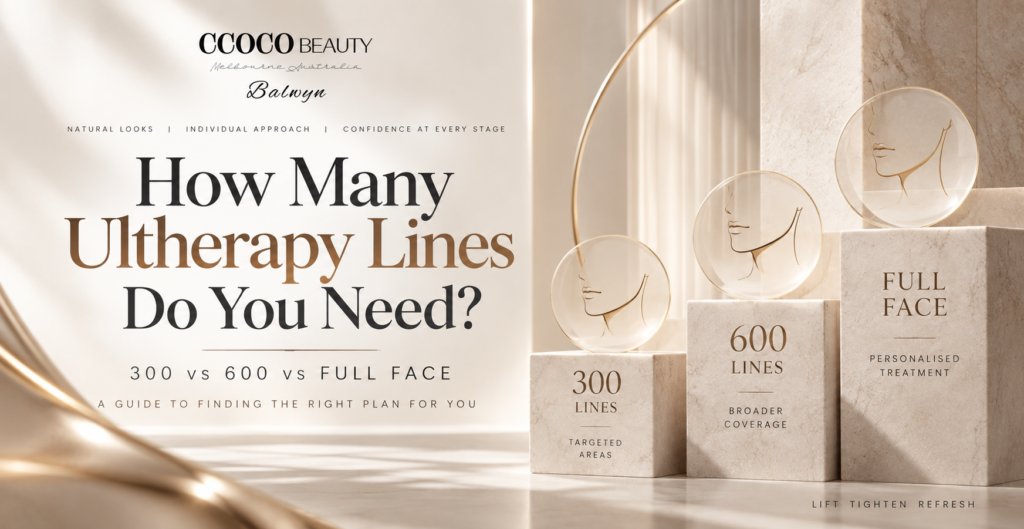
If you've been comparing Ultherapy treatments in Melbourne, you've probably noticed packages advertised by line count — 300 lines, 400 lines, 600 lines, full face, face and neck. It's easy to see why this makes Ultherapy seem fairly straightforward: just pick the package with more lines and assume you'll get a better treatment. But that's not really how Ultherapy works.
Line count matters, but it's only one part of a complete treatment plan. Your facial anatomy, the treatment area, tissue depth, degree of skin laxity, and where those lines are actually placed all play a role in how a treatment should be planned. So instead of asking "how many Ultherapy lines do I need?", a more useful question is: where should those lines be placed for my individual concerns?
What Is an Ultherapy Line?
During treatment, the device delivers microfocused ultrasound energy beneath the skin. Each line is made up of a series of controlled thermal coagulation points delivered at a selected tissue depth, and Ultherapy uses different transducers to reach depths of 1.5mm, 3.0mm, and 4.5mm depending on the tissue being treated. The system also incorporates real-time ultrasound visualisation, which lets the practitioner view the tissue layers and plan energy delivery according to the specific area. This is exactly why two treatments with the same total line count can still be planned in very different ways.
Is 300 Lines Enough for Ultherapy?
It can be, depending on what you're treating. A 300-line treatment is often considered when the focus is on a more specific area rather than an extensive face-and-neck treatment — someone mainly concerned about the lower face or jawline, for instance, may need quite a different number and distribution of lines than someone addressing multiple areas at once.
The important thing to understand is that 300 lines shouldn't automatically be read as "half a treatment." If those lines are appropriately selected and distributed for a targeted area, they can absolutely form part of a suitable treatment plan. That said, 300 lines may not offer enough coverage when several areas are being treated together.
What About Ultherapy 600 Lines?
Ultherapy 600 lines is a commonly searched option because it allows for broader treatment coverage. Depending on your anatomy and treatment plan, a larger line count may allow multiple areas to be treated at once — the lower face, jawline, under the chin, neck, and other selected areas. Still, 600 isn't some universal "ideal number." The official Ulthera system itself recommends line counts by treatment region, which reinforces that planning should be tied to the region being treated rather than simply choosing the biggest number available. In other words, total line count only really means something alongside where those lines are placed and at what depth they're delivered.
Does Full Face Always Mean 600 Lines?
Not necessarily. "Full face" gets used a lot as a marketing term, but it doesn't describe one standardised Ultherapy protocol — one clinic's definition of full face may look quite different from another's. More to the point, no two faces are exactly alike in size, shape, tissue thickness, skin laxity, facial structure, or priority areas. That's why it's far more useful to ask exactly what areas are included and how the treatment will be planned, rather than relying on the phrase "full face" alone.
300 vs 600 Ultherapy Lines: What's the Difference?
| 300 Lines | 600 Lines | |
|---|---|---|
| Treatment coverage | More targeted | Broader coverage |
| Suitable areas | Selected areas | Multiple areas may be treated |
| Lower face | May be considered | May allow broader planning |
| Face + neck | May be limited depending on anatomy | More commonly allows wider coverage |
| Better results automatically? | No | No |
| Treatment planning required? | Yes | Yes |
The key difference here is generally coverage, not treatment quality. 600 lines simply gives you more lines to distribute — but those extra lines still need to be placed thoughtfully to be worth anything.
Are More Ultherapy Lines Better?
Not automatically. It's an easy assumption to make — more lines means more energy, which surely means a better result — but Ultherapy is more nuanced than that equation suggests. The goal isn't to deliver the largest possible number of lines; it's to plan treatment around the tissue that can actually be appropriately targeted. Real-time visualisation matters a lot here, since it lets the practitioner identify tissue layers and choose between depths like 1.5mm, 3.0mm, and 4.5mm accordingly. In practice, placement, depth, coverage, and individual anatomy combined can matter far more than line count on its own.
Why Can Two People Need Different Line Counts?
Picture two clients who both want to improve their jawline. One has relatively mild laxity concentrated around the lower face. The other has concerns spanning the lower face, jawline, under-chin area, and neck. Even if they're a similar age, their treatment plans could end up looking completely different. What drives that planning includes facial anatomy, the treatment area, tissue depth, degree of skin laxity, the size of the area being treated, any previous treatments, and individual goals — which is exactly why there's no single Ultherapy line count that suits everyone.
What Should You Ask When Comparing Ultherapy Packages?
Rather than comparing clinics purely on 300 lines vs 600 lines vs price, it's worth asking a few sharper questions: What areas are included? Which tissue depths will be treated? How will the lines be distributed? Is the treatment plan actually customised to my anatomy? Does the device offer real-time ultrasound visualisation? These questions will tell you far more about the treatment you're actually getting than the line count ever could on its own.
Ultherapy 600 Lines in Melbourne
At Ccoco Beauty Balwyn, we approach Ultherapy as an individual treatment plan first, and a number of lines second. Before treatment, we assess the areas you'd like to improve and work out how the available lines should be distributed according to your facial structure and concerns. For some clients, a more targeted treatment makes the most sense; for others, broader coverage like 600 lines is more appropriate when multiple areas are involved. The real question isn't "how many lines can we use?" — it's "how should we use those lines?"
The Bottom Line
There's no universal answer to how many Ultherapy lines you need. 300 lines may be well suited to a more targeted treatment, while 600 lines may allow for broader coverage — but neither number guarantees a particular result on its own. The quality of an Ultherapy treatment comes down to the overall plan: the treatment area, depth, anatomy, and line placement all working together. So if you're comparing Ultherapy packages, don't just look at the number — look at the treatment plan behind it.
Considering Ultherapy in Melbourne?
If you're unsure whether 300 lines, 600 lines, or a broader face-and-neck treatment is the right fit for you, you can arrange a consultation with Ccoco Beauty Balwyn.
Ccoco Beauty Balwyn
266 Doncaster Road, Balwyn North VIC 3104
We'll assess your areas of concern and talk through an individual treatment approach that suits you.
Individual suitability, treatment experience and results vary. A consultation is recommended before treatment.
Book a Consultation